Sunday, 26 May 2013

A Gay Man Killed on New York City Streets


On May 18, 2013 a thirty-two year old homosexual man, Marc Carson, was gunned down on the streets of New York City. At around midnight Carson was walking with a friend in Greenwich Village when he was approached by Elliot Morales and two other Hispanic men. 

Morales was an armed bigot who made several homophobic comments towards Carson. Carson ignored the offencive homophobic comments and continued walking. One of the Hispanic men left while Morales and the other man followed Carson and his friend. 

Morales asked Carson if he wanted to die on the streets then he grabbed his revolver and shot Carson in the cheek. A bouncer at a club nearby, who witnessed the murder, said Carson fell to the ground after being shot. Carson was rushed to Beth Israel Hospital and died. 

Morales ran away from the scene. Police caught Morales who confessed to the crime. Morales is charged with murder and criminal possession of a weapon. Morales had a fake ID and refused to identify himself or be fingerprinted. 

There are many questions and concerns about this case. For instance, what was Carson’s friend doing while Carson was shot? Why wasn’t Carson’s friend shot? Was this a hate crime or is Morales psychotic? 

These questions are not easy to answer. Morales also claimed to be the Newtown, Connecticut killer. Before Morales shot Carson he urinated in front of a club. When the bartender confronted him, Morales said he was the Sandy Hook shooter and if the bartender called the police he would shoot him. 

Morales anti-gay comments suggests the murder was a hate crime. Morales targeted Carson because he was a homosexual man. Carson was wearing a tank top, cut off shorts, and boots. Morales inferred Carson was gay based on his outfit. 

Even if there were other motives for Morales to murder Carson, his primary motive was Carson’s sexuality. This case greatly effects the homosexual community. Homosexuals walking around late at night need to be cautious. 

This case is disheartening because there are still people that are homophobic and will act in violence against the gay community. How will the homosexual community respond to this act of violence? Will there be stricter gun laws because of this incident? How can we ensure the safety of the homosexual community and any other marginalised group? These are all questions that will hopefully be answered from this case. 

1. http://www.nytimes.com/2013/05/19/nyregion/killing-in-greenwich-village-looks-like-hate-crime-police-say.html

The Political Economy of the Media and Investigative Journalism


During our last lecture of the semester, we discussed the political economy of the media and investigative journalism. The media represents our choices and values which varies between countries. For instance, the media in Australia demonstrates a capitalist democratic society while in China the media is heavily regulated. 

The owners of the media shape the values expressed. In the United States and Australia the media is owned predominately by white middle aged men. Therefore, other ethic groups, ages, religions, socio-economic classes, and sexes aren’t represented in the media. The representations of other groups in the media are from the perspective of middle aged white men. 

Politics and the media influence each other. The media has a large impact on elections. For instance, in the first televised election between John Kennedy and Richard Nixon appearance on television played a large role. Nixon did not wear make up and was released from the hospital a few days before the debate. Nixon looked worn out and Kennedy, who wore make up looked young and vibrant. The polls showed people watching the debate thought Kennedy won and people listening to the debate thought Nixon won. The fear of not performing well and appearance on television intimidated presidential hopefuls and it was sixteen years before another debate was televised. This is an example of media platforms having an influence in politics. Politicians rely on the media to deliver messages to the public.
Clip from the 1960 Presidential election. 

During the lecture we discussed investigative journalism. I am very interested in the area of investigative journalism because the public has a right to know about issues that are harder to report on than news stories on topics such as crime. Investigative journalism requires in depth research on a particular topic. 

When I hear investigative journalism I think about early investigative reporting and muckrakers such as Upton Sinclair, the author of The Jungle. The impact of investigative journalists such as Upton Sinclair changed society and journalism. The Pure Food and Drug Act of 1906 and the Meat Inspection Act resulted from public pressure after reading The Jungle. 

Investigative reporting takes time and patience, but I believe it is worthwhile. I aspire to have an impact on society and reveal the truth about certain topics. Investigative reporting is important for society and serves the public interest. Sinclair inspires me to find a story, investigate, write and hopefully have a large impact on society. 

Monday, 20 May 2013

The First Ag-Gag Prosecution


Amy Meyers, a woman from Utah, used her cellphone to take videos of cows being slaughtered at a meatpacking company in Draper City, Utah. Meyers was changed with agricultural operation interference.

The recording of agricultural operations while trespassing or under a false pretence is against the law under the new “ag-gag” law. Meyers is the first person prosecuted under the new “ag-gag” law. 

Meyers claims she was standing on public property while video taping the cows, therefore she would not be in violation of the “ag-gag” law because she did not step foot into the meatpacking company. 

After video evidence showing Meyers standing from public property was given to the prosecutors, the case was dismissed.

Meyers case only gained media attention after Will Potter blogged about her case and posted about her story on Reddit. 

Meyers is an animal rights activist and even though her case was dismissed, there might be a chilling effect as a result of her prosecution. Even though Meyers was on public property she was still taken to court, other activists might not be willing to risk their freedom to take a video of slaughterhouse conditions. 

The conditions in slaughterhouses are already intolerable, and those owning slaughterhouses knew there could be a possibility their actions could be recorded. The “ag-gag” law gives slaughterhouse owners too much power. How will be know the conditions of slaughterhouses if we are not able to record the practises? How will corruption in the meatpacking industry be revealed? 

There is great public interest about the conditions of slaughterhouses. Journalists and activists are not being given freedom of speech. First Amendment rights are being jeopardised and journalists are not able to properly report on injustices in the meatpacking industry. This law is helping to protect the meatpacking industry. 

This law might encourage other industries to demand special protections from their practises being exposed to the public. This case is important for the future of journalists and activists. How are journalists going to report on news if they are afraid of being prosecuted? Journalists are supposed to be “watch dogs” and this law disables journalists from being able to properly carry out their job. 

Hopefully, journalists and activists will be able to find new ways of obtaining their information that will not cause them legal problems. 

1. http://myveganjournal.com/wp-content/uploads/2013/04/ag_gag_poster.png

2. http://www.opednews.com/articles/First-Ag-Gag-Prosecution-by-jana-claire-130429-452.html

Is Lila Carney the Best New Addition to Quinnipiac?


After meeting Lila Carney on three separate occasions, its not hard to see she is an optimistic, enthusiastic and bubbly new addition to the faculty at Quinnipiac University. 

Carney is not new to the world of journalism. Carney knew she wanted to work in the communications field from a young age. 

“Growing up I was always kinda a news nerd and watched the evening news every night at dinner” said Carney. 

Carney has an impressive work history. She interned as an assignment editor at NBC. 

Later, Carney became a reporter and worked as one man band in broadcast journalism. Carney said that this job was stressful because she had the responsibility of three people. 
When Carney was a reporter she covered numerous local stories. Her stories included anything from an honourable citizen rescuing a dog to a murder case.

Recently, Carney worked as a professor at the University of Connecticut. Carney likes to work in the education field because she can “keep her feet wet in journalism.”

At the university Carney is the assistant director for social media, teaches journalism 160 and the introduction to media studies, is a member of the academic integrity board and is affiliated with numerous organisations at Quinnipiac. 

Amanda Shulman is sophomore at the university and the photo editor of the Chronicle. Shulman works directly with Carney and describes her as “awesome, dedicated, and caring.” 

“I wish I could take her class, I feel like she would be an awesome professor,” Shulman said. 
Jamie DeLoma describes Carney as “a pleasure to work with.” 

Last week DeLoma taught Carney’s class about AP style. Deloma and Carney are both AP style enthusiasts.

DeLoma would love to teach a joint class with Carney. DeLoma said the best classes are the ones with two professors, because you get two different perspectives on life. 

Carney is very personable and is prepared to help guide her students. Carney’s best piece of advice is to “be a sponge” and willing to learn. 

Carney plans to work at Quinnipiac for several years. In the future she wants to return to news reporting. 

Friday, 3 May 2013

Ethics in Journalism


This week during lecture we discussed ethics in journalism. Ethics is a controversial issue because everyone has their own personal ethics. Since journalists do not need a license to practise journalism, ethics becomes important for a journalist’s credibility. Many credible journalists join groups such as the Media Entertainment and Arts Alliance in Australia. 

I believe there should be a set of ethics for journalists. In order for journalists to serve in the public interest there needs to be credible and ethical journalism. When journalists are very unethical there is public backlash, but there are no serious consequences for the journalist. 

Some people would be willing to take photos of a person about to cause themselves harm instead of trying to intervene in the situation and help the person. Journalists have a responsibility to report on stories that are of public interest, but this does not mean that journalists can forget about their morals. Morals differ for each person, but I do not believe a story is worth a human life. 

During the tutorial our class discussed certain cases in which journalists were faced with a dilemma. In one instance, two photographers watched and filmed a man setting himself on fire. After thirty-seven seconds one of the camera men helped the man while the other camera-operator continued to film the situation. Since I was not in the situation it is hard to say exactly the steps I would have taken, but I would like to believe I would have helped the man. 

I do not understand how people can distance themselves from other humans in order to complete a job and write a story. I would feel incredibly guilty if I watched another being suffer and did not try to help. 

I believe there should be some guidelines for all journalists. Journalists should intervene in situations that are life-threatening. Their job as a journalist does not override their ability to help others. Although journalists are not trained paramedics or humanitarians, if they are witnessing a situation in which they could help, they should stop writing the story and help the victim. 

As an aspiring journalists I was shocked by some of the case studies and for some I was pleasantly surprised. When I am a journalist I will try to be compassionate and help others while still being able to report stories. 

The Stress and Trauma Journalists Face


During our journalism lecture we discussed war reporting and trauma in journalism. Before this lecture I did not realise that journalists experience trauma or post traumatic stress disorder from certain stories they have covered. 

Journalism is an undervalued profession. Journalists expose injustices to the public, are constantly on the job, and have to report on disturbing situations. Journalists report stories for the public and most people do not respect and even despise journalists.  

As a journalist, you have to be willing to accept all of the positive and negative aspects of your job. Not all people will appreciate the value of the work that journalists do, but it is an important task that needs to be carried out in society. 

Sometimes as a journalist there will be times when your boss will ask you to report on a war or a dangerous situation and you have to be willing to say no. There is no shame in saying no to reporting a story you are uncomfortable with. If you are not mentally stabile to report on a story that might cause trauma it is not worth risking your own sanity. 

After hearing about the story of Kevin Carter, an award winning South African photojournalist. Carter had an extremely hard life after joining the Air Force, then becoming a disc jockey at a radio station, and finally deciding to become a photojournalist. Cater had experimented with multiple types of drugs. 

As a photojournalist, Carter had seen many traumatic events. He started to experience post traumatic stress disorder aside from his other drug issues. He took many disturbing pictures while he was a photojournalist which had a very big impact on his mental state. He was unable to cope with the trauma he was facing and committed suicide.

As a journalist it is important to confront issues of trauma or post traumatic stress disorder. Traumatic situations are hard to talk about but journalists need to talk otherwise the past might haunt them. 

When I become a journalist I will not be a war reporter, but if I am reporting on a situation in which I feel is traumatic I will seek help. After watching a video in class about journalists that have been treated for their post traumatic stress, it is more important to deal with mental issues than care about your image or being perceived as weak. 

Thursday, 2 May 2013

The Boston Marathon Bombings


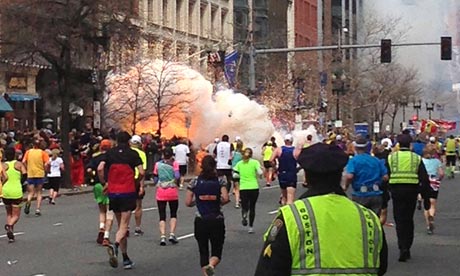
On Patriots Day, April 15, 2013 two bombs went off at the Boston Marathon. Three people were killed and over 144 people were wounded. Many people lost their limbs as a result of the attack. 

Obama vowed to find the people responsible for the attack and these people would “feel  the full weight of justice.” As a response to the attacks on Boston: Washington D.C., New York, Los Angeles, and all other major United States cities were under red alert and security was tightened. 

When I first heard of these attacks I was in the Refect on James Cook University campus. I saw the television out of the corner of my eye and through all noise in the Refect all I heard was Boston. I walked closer towards the television to find out Boston had been attacked. 

I quickly rushed back to my room and researched new articles to find out the specifics about the attacks. Then I called my friends in Massachusetts, hoping none of their friends and family were at the Marathon. Luckily, all of my friends and their family’s were safe. Then I called my family to make sure there were not any attacks in New York. Thankfully, all of my family and friends were able to stay safe during the attacks. 

I was really upset about the attacks because I was reminded of the tragedies of September 11. I was only in the second grade, but I remember that day very clearly. Every child was being sent home. For the children whose parents worked in the World Trade Centre, they were called in the principles office to wait for a family member to pick them up. 

Thankfully, the Boston Marathon bombings did not have as many civilian casualties as September 11. Instead, these bombings caused fear in society. People do not feel safe going to large public gatherings because their safety might be at risk. 

After locking down the city of Boston, police found the two Russian bombers after they were causing more chaos in Boston. Apparently the two Russian bombers were on their way to New York. 

This attack hit very close to home. Many of my friends are from Massachusetts and I have been to Boston countless times. I have never felt unsafe in the city of Boston, but after these attacks I will be more cautious in large public gatherings in cities.